ARTICLES
2026.09.01
Innovation Emerges Beyond Boundaries — Rethinking Design and Talent in the Age of AI
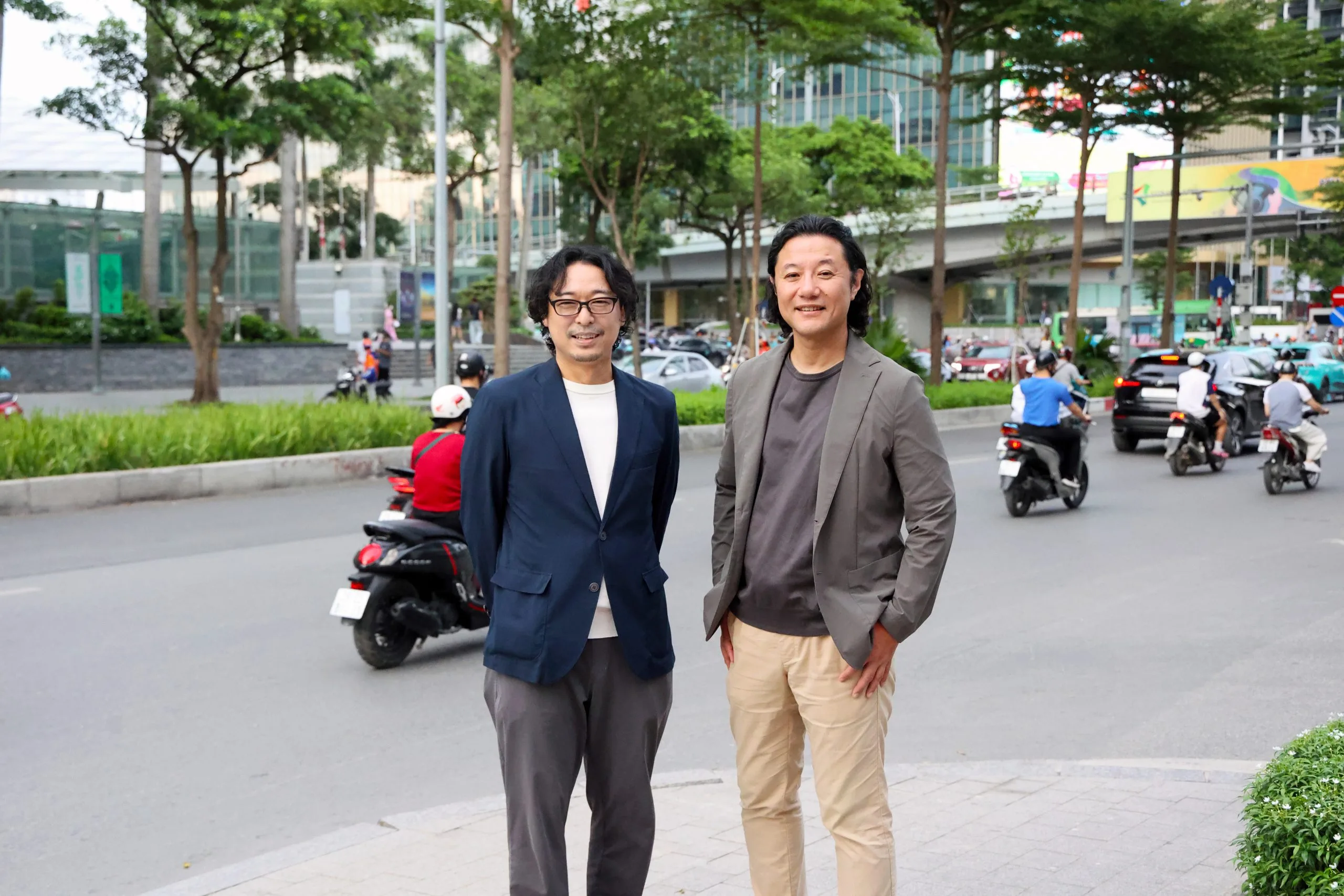
Guided by its vision, “Design Beyond,” FOURDIGIT has continued to move beyond boundaries—across industries and national borders, and beyond conventional definitions of design—while building its business in Japan and overseas with service design at its core.
What began with web design has evolved into the design of services and businesses themselves. Today, FOURDIGIT’s work continues to expand into new areas, from international business and approaches to social issues to the development of the next generation of talent.
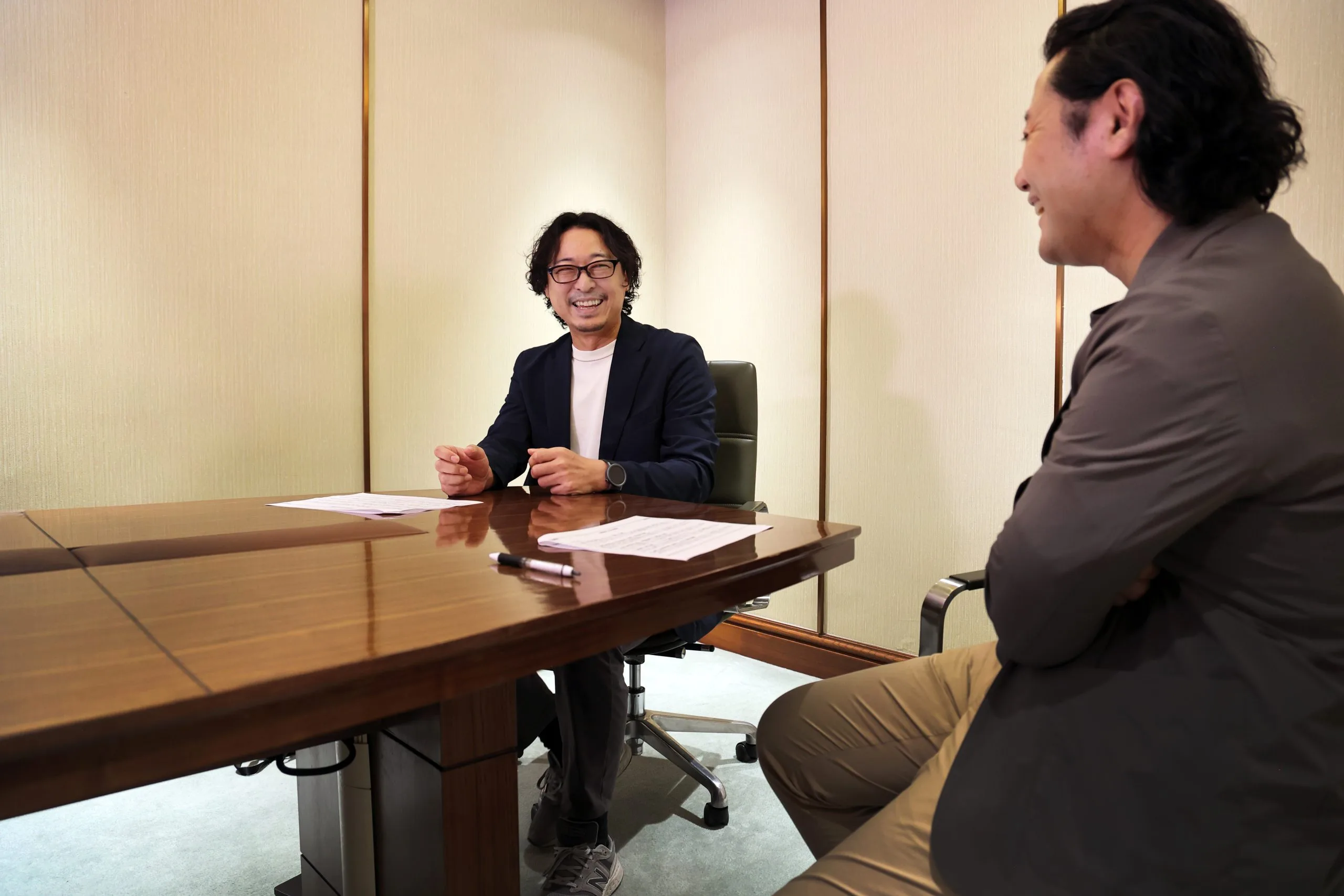
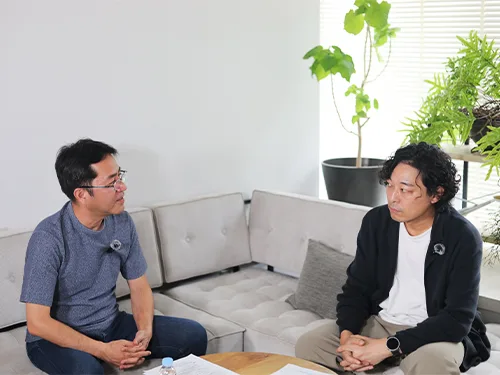
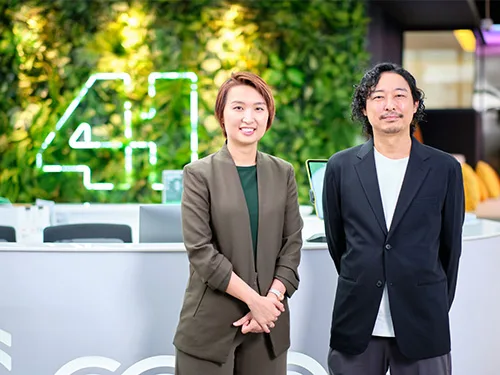
How do these initiatives look from the perspective of management studies? Akie Iriyama, Professor at Waseda Business School, and Ryo Taguchi, CEO of FOURDIGIT, sat down to discuss the value of crossing boundaries as a catalyst for innovation, the role of design in the age of AI, and the kinds of people and organizations that will be needed in the years ahead.
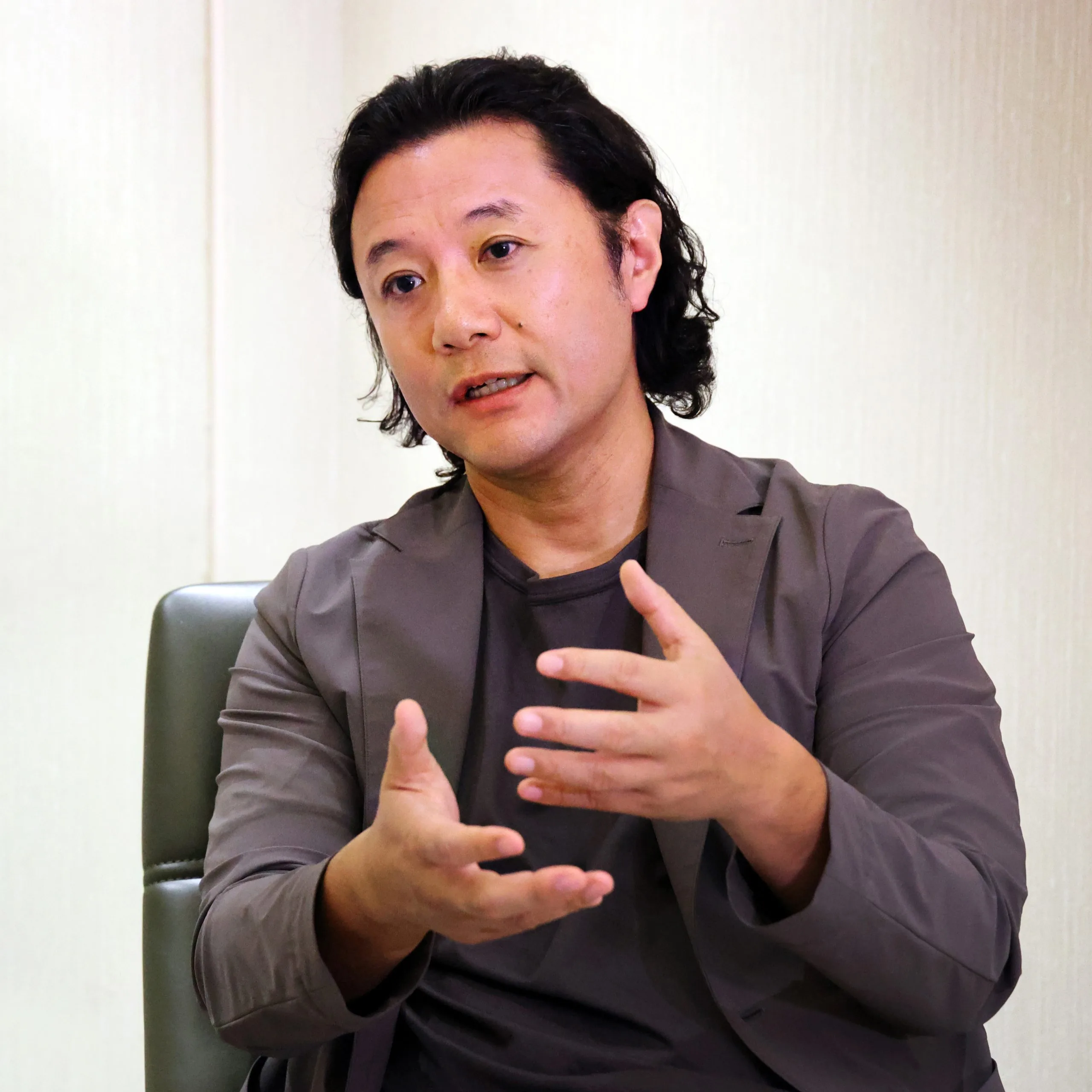
Akie Iriyama
Graduate School of Business and Finance, Waseda University
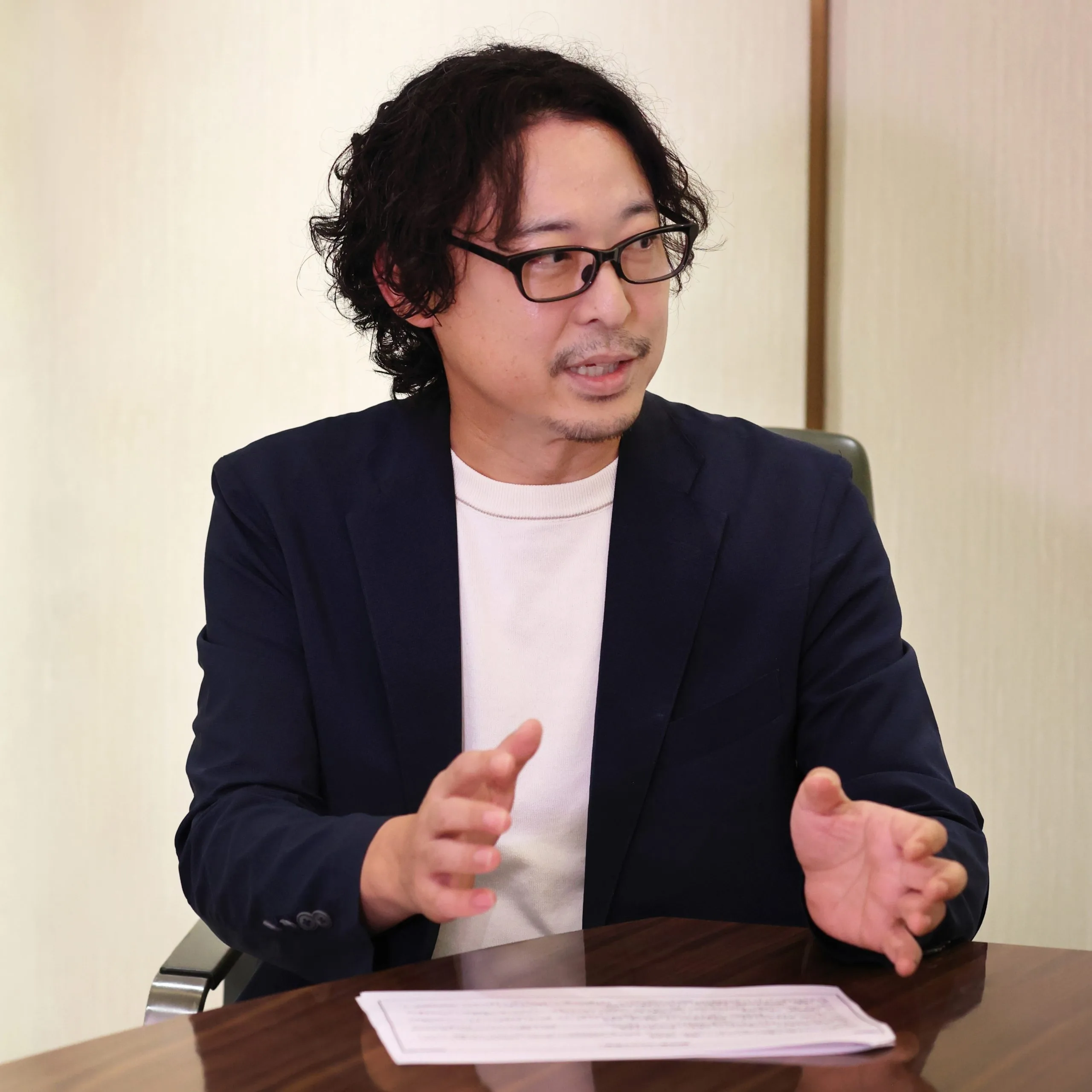
Ryo Taguchi
From Asking “What Should We Make?” to “What Is Actually Needed?”
—To begin, could you tell us about FOURDIGIT’s business and the thinking that led to “Design Beyond”?
Taguchi: FOURDIGIT was founded in 2001, and we started out in web design. As devices such as the iPhone evolved, however, the number of touchpoints between users and services grew rapidly. Concepts such as online-to-offline, or O2O, and omnichannel experiences were also gaining traction, and we began to ask ourselves, “Can we really solve our clients’ problems if all we do is build websites?”
That led to an internal discussion about a more fundamental question: What is design in the first place?
Many design firms specialize in a particular field, such as graphic or package design. But rather than defining our domain first, we thought it might make more sense to use the power of design to address a wide range of challenges.
That was around 2010. Looking back, I think it was essentially the thinking behind what we now call UX design and service design.
Iriyama: 2010 was remarkably early. That was well before concepts such as design thinking became widely discussed in the business world.
Taguchi: The more deeply we engaged with our clients’ challenges, the clearer it became that a single touchpoint was never enough. To truly transform an experience, we had to think not only about digital products, but also about marketing, operations, and sometimes even internal management. Our scope expanded naturally from there.
One project that symbolizes this evolution is “ahamo,” the mobile communications service launched by NTT DOCOMO in March 2021. We joined the project from the conceptual stage as a design partner, working alongside the team from defining what the service itself should be through to designing the overall user experience, including the website and app.
Before we start making something, we first think together about what is actually needed. That remains our fundamental approach to work today.
—FOURDIGIT has also established offices outside Japan. What first prompted the company to expand overseas?
Taguchi: It started when one of our Japanese clients asked us to support an overseas development center.
Once we actually started working on the project, we realized that many things simply would not work unless we had people on the ground. If you are designing a service for local users, you cannot truly design it without people who understand the culture and everyday life of that place.
That led us to establish local offices, and today we have three overseas bases in Southeast Asia.
Iriyama: I think that is a remarkable achievement. Japan has a domestic market large enough that a business can survive without ever expanding overseas. Once you do go abroad, however, you encounter different languages and cultures.
And unlike a physical product, design is not something you can simply put in front of someone and say, “This is what we sell.” For a design firm originating in Japan to have built this kind of presence overseas is fascinating.
Innovation Comes from Connecting Things That Are Far Apart
—FOURDIGIT has crossed many kinds of boundaries, from business domains to national borders. Professor Iriyama, how do you view this kind of boundary-crossing from the perspective of management studies?
Iriyama: I think it is extremely important.
In 2012, I published a book in Japan titled Sekai no Keieigakusha wa Ima Nani wo Kangaete Iru no ka—roughly, What Are the World’s Management Scholars Thinking Today? Interestingly, some of the strongest responses I received came from designers.
One idea that particularly resonated with them was the distinction between exploration and exploitation, which underpins the concept of organizational ambidexterity.
Left to ourselves, people and organizations naturally tend to favor exploitation—deepening and refining what is already in front of us. Yet much innovation comes from new combinations of existing knowledge. That is why exploration is essential: actively searching for knowledge that lies outside or far beyond your current domain.
Another concept that tends to resonate with designers is the “transactive memory system.” The idea is that what matters in an organization is not for everyone to possess the same knowledge, but rather for people to know who knows what.
Both concepts are ultimately about connecting different things. And I think that is precisely where the strength of design lies.
Taguchi: I feel that, across the various things we do, we naturally tend to combine different fields and perspectives.
That is probably why people often ask us, “You’re a design company, right? So what exactly kind of company are you?” (laughs)
To us, all of it is design. But once you try to fit what we do into conventional categories, I can understand why it may become difficult to explain.
Iriyama: But in a sense, I think those categories themselves are a kind of construct.
Categories are concepts that humans have created to make the world easier to understand. Of course they are useful, but they also encourage us to draw boundaries: “This ends here,” or “That is outside our domain.”
If you want to create innovation, being able to think without being constrained by those categories is a major strength.
“Is That Design Too?” Reframing the Question Through Social Challenges
Taguchi: In that sense, I think one initiative that particularly reflects who we are is our employment support program for single mothers in Okinawa.
When I visited Okinawa, I learned about the social issue of child poverty. As I began to understand the circumstances behind it, I learned that Okinawa has a high proportion of single mothers and that economic hardship can persist across generations.
I have children myself, so when people there told me about children who begin to lose confidence in themselves and think, “There’s no way I could ever do that,” I felt very strongly that we had to do something.
So we created a system through which single mothers living in Okinawa could remotely take on part of FOURDIGIT’s work.
Iriyama: Where many people might think, “Let’s make a donation,” or “Let’s provide some kind of assistance,” your response was, “Why don’t we commission our own work to them?” The idea itself is very interesting.
Taguchi: At the same time, continuing an initiative like this naturally costs money. If the model is simply to keep spending money in order to provide support, the initiative ends the moment the funding disappears.
So we began thinking about how we could make it work as a sustainable business. We have explored mechanisms such as establishing a fund and producing short films that credit the people who have supported the initiative, using our creative capabilities to find ways to keep the effort in motion over the long term.
People sometimes ask us, “You’re a design company. How far are you going to take this?” (laughs) But from my perspective, there is simply a problem in front of us, and we are asking what we can do through the power of design to help solve it.
Iriyama: I believe a design firm is fundamentally a company that frames problems and solves them. With that capability, the range of issues you can address is actually enormous.
Conversely, what many Japanese companies may be lacking today is the ability to step back and see the whole picture.
—In terms of “problem-solving,” is design close to consulting?
Taguchi: There are certainly similarities, but I think the stance is somewhat different.
In many cases, a method or framework comes first, and the business model is built around applying it to a particular problem. But what we really need to ask is, “What should we actually do about this problem?”
There is no predetermined correct answer in design. We gradually give shape to something ambiguous and search for the answer together with the client. I believe that process itself is important.
Iriyama: My understanding is also that consulting often begins from a point where the client’s problem is already understood to some extent.
A design firm, on the other hand, can begin one step earlier by asking, “Is that really the problem in the first place?”
AI will enable us to solve more and more problems. That is precisely why the ability to identify the problems that are truly worth solving will become more valuable than problem-solving ability alone.
I think that is also where the importance of design lies.
What Japanese Companies Need: Curiosity and Courage
—Many Japanese companies are said to be inward-looking. What does it take to move beyond that and cross boundaries?
Iriyama: This may not sound like a very academic answer (laughs), but I think it comes down to curiosity and courage.
Japan once had such a large domestic market that companies could become some of the world’s leading businesses while competing almost entirely within Japan. But the environment is completely different today. With Asia’s presence continuing to grow, it is difficult to keep growing if you only look inward.
One reason people hesitate to go abroad, I think, is a lack of confidence in their English.
But much of the English used around the world is not perfect English spoken between native speakers. It is non-native speakers communicating with one another, making mistakes along the way. So in reality, you can manage even if your English is not very good.
What you need is the courage to say, “It doesn’t have to be perfect. I’ll try anyway.”
Taguchi: When I’m overseas, I often get by with individual words and phrases too (laughs). The other person may also be a non-native speaker, so they generally do not care that much about mistakes.
Speaking English well and being able to work globally are not necessarily the same thing.
Iriyama: Exactly. And on top of that, you need curiosity. Can you think, “I don’t know, so I want to go and see for myself,” or “I want to talk to people from a completely different world”?
Ultimately, I think that is where crossing boundaries begins.
In the Age of AI, Education Will No Longer Be About What You Can Memorize
—In June 2026, FOURDIGIT held “SYNC Design & Innovation in SITE 2026” in Bangkok, Thailand, a festival bringing together design and business. What kind of challenge or concern led you to create the event?
Taguchi: Thailand was the first country where FOURDIGIT established an overseas office.
Thailand has an exceptionally high level of specialization in fields such as architecture, film, and graphic design—the ability to pursue a single discipline to great depth. At the same time, the economy and digital environment have developed extremely rapidly through a kind of “leapfrogging.”
As a result, I sometimes felt that the market itself was moving ahead before enough practical experience in areas such as service design and UX had been accumulated.
If that continued, it would also be difficult to develop enough people capable of leading those fields.
We concluded that two things were necessary: changing perspectives on the industry side, and developing talent.
On the talent-development side, we began teaching service design at universities. Today, we teach classes at seven universities in Thailand, and more than 300 students have participated in our programs in total.
And because we also wanted to create change on the industry side, we launched “SYNC.” Thailand’s National Innovation Agency, or NIA, supported the vision, allowing us to co-host the event.
—What specifically do you teach at universities?
Taguchi: For example, we might ask students to work on a theme such as “Design a service for first-year university students.”
Instead of simply listening to lectures, they first picture a first-year student around them and think about what that person’s daily life is like and what difficulties they might be facing. From there, they identify a problem, generate ideas, develop those ideas into a service, and ultimately present their proposal. They work through the entire process as a team.
What I consider most important is not how much knowledge they memorize, but the dialogue that emerges along the way.
Some people are good at keeping a conversation moving. Some are good at bringing different opinions together. Others pick up on someone else’s idea and make it even better. There are many different roles within a team.
When a class awards academic credit, evaluation is of course necessary. But rather than asking, “How much of what we said in the lecture did this person remember?” we try to look at, “What did this person make better within the team?”
One university professor once told us, “I’ve never seen a student who usually sleeps through class look so engaged and animated in discussion.”
The more AI advances, the more I believe that the abilities revealed through experiences like these will become important.
Iriyama: I completely agree.
Design is important precisely because there is no single correct answer.
People often have things they vaguely sense or feel within themselves. They bring those thoughts outside themselves through words, drawings, or tangible forms, and then make them more concrete through dialogue with others. You could also describe that as a process of converting tacit knowledge into explicit knowledge.
And in the age of AI, human skills will unquestionably become more important.
AI will increasingly supplement knowledge itself. That means the middle leaders of the future will need more than the ability to manage.
I describe three essential roles: motivator, coach, and facilitator.
They need to bring out people’s motivation, support their growth, and help people with different perspectives bring their ideas together and move forward. All three are profoundly human capabilities.
What FOURDIGIT is doing at universities is, I think, exactly the kind of education that develops those skills.
When AI Handles Logic and Knowledge, What Value Remains Human?
—Will AI also change the fundamental nature of companies and organizations?
Iriyama: Metaphorically, I think of AI as something like a “fourth brain.”
The human brain has areas responsible for sustaining life, areas related to emotions and social behavior, and areas associated with logic, calculation, and reason. I imagine AI as an additional layer sitting outside all of those.
AI excels at logic, calculation, and the processing of knowledge. If you think about it that way, what remains distinctively human are areas such as emotion, physicality, and our relationships with other people.
In the future, simply being “convenient” may no longer be enough to create meaningful value.
By contrast, things that move us emotionally—entertainment, brands, food, sports—may become increasingly valuable. Japan is a country that has long had strengths in many of these areas.
So rather than focusing only on the idea that AI will eliminate jobs, I think we are heading into an incredibly interesting era.
Taguchi: Running a business today, I sometimes feel as though we are circling back to an earlier time.
Until now, there has been a strong emphasis on working in ways that are fair and as independent as possible from particular individuals. As a result, we have moved toward systematizing work and removing the human element from it.
But the further we move into the AI era, the more I think that human relationships and trust—ultimately, who you choose to work with—may become important again.
I felt that very strongly when we held SYNC in Thailand. It became a major movement precisely because we met so many people face-to-face, talked with them directly, and built connections through trust between individuals.
I think value may begin to return to those more personal, relationship-driven connections.
From “What Do You Know?” to “How Have You Lived?”
—How should companies recruit and develop people with those kinds of human skills?
Iriyama: I think the way we think about recruitment will also change.
At one company where I serve on the board, there was a woman who had originally been working part-time and demonstrated remarkable leadership. After becoming a full-time employee, she continued to deliver outstanding results.
I wondered, “Why is she so good at managing people?” When I asked her about it, I discovered that she had been the captain of a local “mama-san volleyball” team—a community volleyball team for mothers.
Bringing together a community like that requires considerable facilitation skills and leadership. Those are qualities that are very difficult to identify from academic credentials or knowledge alone.
I also joke that I “only take unusual people” into my university seminar (laughs). But once you stop relying on easy-to-understand criteria such as academic scores or university pedigree and instead try to judge the individual themselves, the person making the selection needs courage as well.
Taguchi: I completely understand that. At FOURDIGIT, we spend a great deal of time on hiring interviews, and we sometimes ask candidates to talk about their lives all the way back to where they were born.
What kind of child were you in elementary school? What position did you play on your sports team? What role did you naturally take within a group? We explore questions like those in considerable depth.
And when you keep digging, sometimes a story comes out such as, “I studied abroad in the United States, accidentally ended up in an area with serious safety concerns, and had to live there for a while.”
And we think, “That is quite an experience.” (laughs)
Iriyama: Experiences like that are significant (laughs).
I believe that having experienced being in the minority when you are young, or having been placed in a genuinely difficult situation, can make a tremendous difference.
Experiences like that can give you a healthy sense that, one way or another, you will find a way through. I think that becomes a source of strength.
Taguchi: Looking back at FOURDIGIT’s executives, many of them do have somewhat unusual backgrounds.
I myself made my debut in music when I was a student and worked as a professional musician. But there was a period when we simply could not succeed commercially. In trying to sell our music, I learned how to use the internet and started building websites. That eventually led to the work I do today.
Other members of our leadership team have had completely unexpected experiences overseas, or grew up abroad before coming to Japan. Each of us has followed a path that is a little different from the conventional one.
Thinking about it again, perhaps we really are an unusual team (laughs).
And when I consider all of that, I think one quality that will become particularly important is openness—or what might be described as the ability to unlearn. It is about not clinging to what you already know or what you have built up in the past, and remaining willing to change.
At FOURDIGIT, our vision is “Design Beyond.” It represents the idea of exploring how far we can move beyond existing boundaries through the power of design.
And I believe that mindset of crossing boundaries is necessary not only for the company, but for every individual as well.
Iriyama: I agree. Being placed in an environment different from your own when you are young, or going through experiences where things do not go the way you expected, can be tremendously valuable.
Those experiences give you that same resilient sense that, somehow, you will find a way through.
In the years ahead, I think experiences like these will only become more valuable.